

The right CFO for the right phase
5 min read
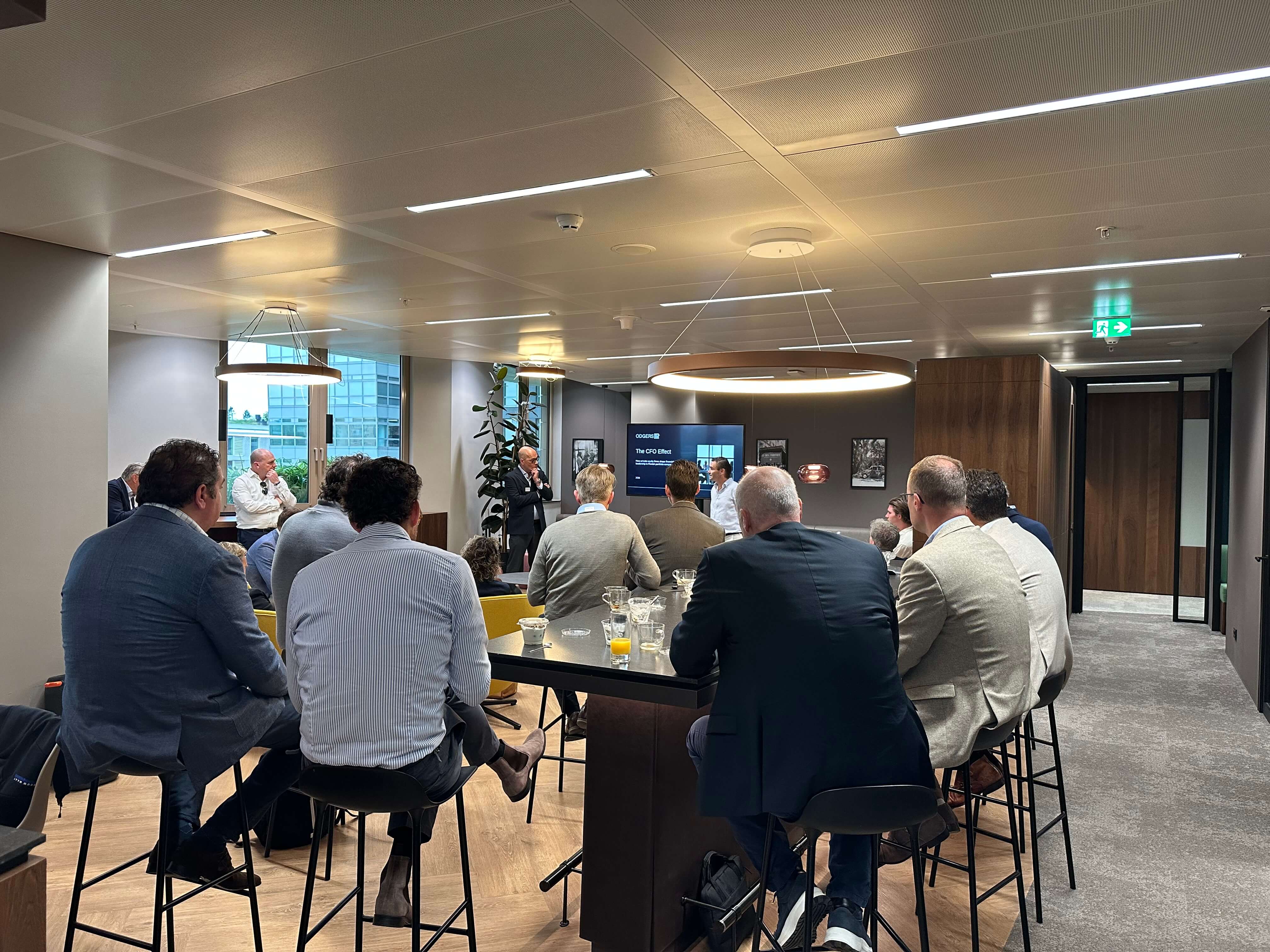

What a morning with CFOs teaches us about mandate, timing and the tandem with the CEO. On Friday morning, 8 May, a group of CFOs and senior finance executives gathered at the Odgers office. Breakfast at half past seven, a 45‑minute session, a topic that deepened as the conversation progressed. The occasion was new research by our Finnish colleagues into CFO appointments in private equity. The session was led by Pieter Ebeling, Partner and Head of Private Equity Europe at Odgers, together with Michel van den Bogaard, CFO at Signicat. What followed was not a presentation, but a conversation, shaped by the experiences in the room.
Why this theme and why now
CFO turnover in private equity is more the rule than the exception. The Finnish research shows that 73% of portfolio companies appoint a new CFO during the holding period, with almost a third doing so more than once. Only 20% change at entry; the average change takes place 3.2 years into the hold. Pieter noted that practice in the Netherlands looks different. After an acquisition, around 90% of the management team is replaced, and CFOs, in his experience, strikingly often. International, larger PE firms tend to act earlier, sometimes already during due diligence; Dutch PE firms more often take time to see whether the incumbent CFO is the right fit.
Two questions ran through the discussion: when are you the right CFO for the right phase, and what explains why one CFO stays until exit while another is replaced halfway.
First-time CFOs, a surprising observation
One of the sharpest findings from the research was that prior PE CFO experience is not a predictor of success. Only 32% of appointed CFOs have previously held a CFO role in a PE environment. First‑time CFOs show the longest average tenure (4.2 years), and CFOs with general CFO experience outside PE most often remain until exit or beyond five years (64%).
Pieter recognised this in the Dutch market. The last three to four CFO appointments Odgers has made in the MKB+ segment were first‑time CFO roles, a shift from a few years ago, when PE firms almost exclusively looked for prior PE experience.
The transition from corporate
A participant with a long background at Reckitt Benckiser, now active in Consumer Health, described the transition from corporate to PE. The biggest shock was not strategy or governance, but data. Where systems, master data and specialist teams are taken for granted in a corporate environment, these are often lacking in PE portfolio companies. Insight first has to be built before it can be used. Corporate experience remains valuable as a frame of reference, but cannot be applied one‑to‑one. Resilience, the participant observed, was ultimately the answer.
Director of the company, not a delegate of PE
A second participant, with more than twenty years of CFO experience in PE, shared an observation about the relationship with the shareholder. Too often, the PE firm is seen as something that only the CFO needs to manage. The CEO has a role of their own, at a different level of the conversation. When that is absent, the CFO constantly switches between an abstract level and a detailed level, and the balance between company and investor is lost. The value lies in a broader coalition, in which CEO and CFO each maintain their own line to the shareholder.
Michel articulated his own position in response. He sees himself first and foremost as a director of the company, not as an extension of the shareholder. He summarises that role for himself in three elements: the equity story (why this company is valuable), the exit (are the financials of the past three years aligned with that story, statutorily and managerially), and execution (do we actually realise those numbers). Anyone who does not make explicit on entry where their responsibility begins and ends will confront that difference later on.
The tandem with the CEO
Michel repeatedly emphasised the relationship between CFO and CEO as the most important success factor, possibly even more so than prior PE experience. Especially when the CEO is also the owner‑manager, this requires investment. He spoke about his first PE role at a Dutch rose grower with KKR as shareholder, a family business with €200 million in revenue and minimal administration. The owner‑manager, by his own account, did not need a bookkeeper and initially saw Michel mainly as KKR’s bookkeeper. Only by investing time in the relationship, including literally going along to the nursery, did space emerge to stand alongside each other rather than opposite each other. That tandem ultimately became the backbone of the sale process. Investors want to hear the story from CEO and CFO together. That requires a single front, also towards PE.
The first months, and managing expectations
One participant described how, at a second PE entry, he joined with less naivety, based on the assumption that a platform company is in reality usually messier than presented beforehand. Buy‑and‑build trajectories often result in a pile‑up of administrations that are never properly integrated. His approach: in the first sixty to one hundred days, get clarity on the real state of affairs, draw up a clean‑up plan per KPI, and align that plan with the shareholder at an early stage.
Michel added his own practical experience. Temporary clean‑up costs, which he referred to during the session as ‘Mickey Mouse money’, can be normalised out of EBITDA through run‑rate normalisations, provided this is flagged with the shareholder upfront. When new expectations arise along the way, such as an additional acquisition, technical debt from a new stack or an adjusted KPI set, it is the CFO’s task to make explicit what this means for the original agreements.
Pieter recognised in this the pattern of what he has previously called the CFO graveyard: companies where successive CFOs come unstuck because the real work of building data foundations and achieving harmonisation is repeatedly postponed as the exit draws closer.
Five takeaways
- The right CFO is phase‑specific. What works in a buy‑and‑build phase rarely works in an exit phase. Naming this upfront in mandate and expectations prevents foreseeable disappointment halfway through.
- Prior PE experience is not a predictor of success. First‑time CFOs and CFOs with strong corporate experience show longer average tenure than seasoned PE CFOs. In selection, capability and attitude weigh more heavily than label.
- The CEO–CFO tandem is decisive. Invest early in that relationship, especially when the CEO is also owner‑manager. One front towards PE creates more value than a perfect dashboard.
- Managing expectations is a continuous discipline. Diagnose sharply and plan in the first sixty to one hundred days. Thereafter, with every new request from the shareholder, make explicit what this does to the original plan.
- A broader coalition reduces pressure on the CFO. When the CEO also maintains their own line to the shareholder, the CFO does not need to constantly switch between abstract and detailed levels.
What this morning yielded, beyond the content, was a pattern of mutual recognition among CFOs. Much of what was shared in the room, from data chaos to the squeeze towards exit, was reflected in the silent nod that followed. The next session is scheduled for 5 June, again in a PE context, with resilience as the theme. To register, send an email to events.nl@odgers.com.

Never miss an issue
Subscribe to our global newsletter to discover our latest insights, opinions and featured articles.
Follow us
Join us on our social media channels and see how we're addressing today's biggest issues.