

Leading Through Uncertainty
The only certainty is that uncertainty remains
8 min read
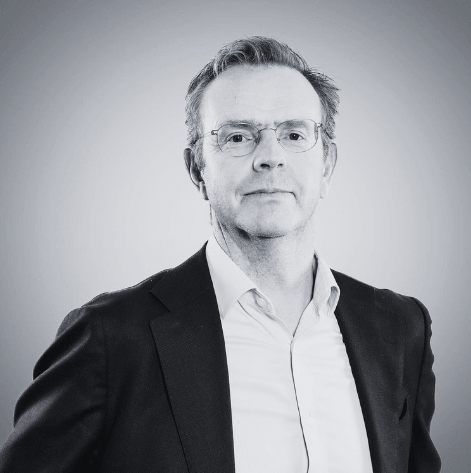

What makes leadership successful in uncertain times? In a series of interviews, Odgers Netherlands shares inspiring insights and leadership lessons from the practice of top executives. In this second conversation: Mark Siezen, CEO of Bouwinvest. He grew up as a child who moved from one city to another time and again, worked in China and discovered there that his tried-and-tested approach fell completely short, and has since led a major transformation at one of the largest real estate investors in the Netherlands. Geopolitical unrest, a changing pensions landscape, AI and rising interest rates: the external pressure on his sector has rarely been this great.
The only certainty is uncertainty
Siezen has an outspoken view on the matter: the term crisis has become hollow. In the past, you had a crisis, you resolved it and stability returned. That model no longer holds. Uncertainty is not something that passes — it is the permanent state. Those who wait for calm before taking action wait too long.
His answer to that permanent uncertainty is a distinction that gives him something to hold on to: certainty in the long term, based on macro-trends such as demographics and geopolitics, and uncertainty about the road to get there. That road is anything but fixed. But the direction is. That distinction, horizon versus route, makes the difference between paralysis and movement.
For Bouwinvest this means, in concrete terms: knowing roughly where the real estate market will stand in ten years' time, based on demographic developments and the energy transition, while the daily course is continuously adjusted. That calls for an organisation that does not steer on certainty, but on adaptability. And a leader who knows the difference between what he can influence and what he has to let go.
The word crisis has been completely overused and has lost all its value. The only certainty is that things will be uncertain again.
Inward first, then outward
When something unexpected happens — a key person who suddenly leaves, an external shock that hits the strategy — Siezen's first move is directed inward, not outward. He has learned that whoever first looks for culprits or causes outside themselves loses control over their own reaction. The solution begins with the question: what does this do to me, and why?
He says it without romanticism. It took him a painful process to learn that: a moment in his career at which he truly hit rock bottom and only then realised that his way of looking at things was itself the problem. That realisation changed him: as a leader, as a father, as a friend. He is grateful for it, even though at the time he would rather have avoided it.
What he adds to this is a nuance he likes to pass on to others: doubt is not a weakness. He would find it more frightening if it weren't there. It gives him perspective, keeps assertiveness in check and makes him a better sounding board for the people around him. But it also has a price: sometimes it costs him decisiveness, sometimes time, sometimes credibility. That is the conscious trade-off.
The moment I start by looking outside myself first, things generally go wrong. The solution always lies with yourself.
Transformation pace and the elastic of the organisation
One of the dilemmas he has wrestled with most during the transformation of Bouwinvest is pace. How quickly can you take an organisation with you without losing it? His answer is not a formula but a heuristic: if roughly half of your people complain that it's going too fast and the other half that it's going too slow, that discomfort on both sides is often a sign that you really are in motion.
That sounds laconic, but it masks a serious leadership task. Because the people who don't keep up demand energy. Siezen acknowledges that he has a tendency to want to please: to take everyone with him, to leave no one behind. He has learned that this tendency can paralyse him. Most of the energy then goes into the 30% who won't or can't, while the 70% who will and can are left waiting.
His conclusion is uncomfortable but clear: what was good does not necessarily have to be good for what is coming. The team that brought the organisation to where it is now is not by definition the team that will take it to the next phase. Saying that comes at a cost. But not saying it costs more.
If half of them said: do you want to blow the place up? And the other half: I thought you were going to change things around here… then you're about on the right track.
Risk-aware is not the same as pessimistic
His wife thinks the glass is always half empty with him. He sees it differently. There is a difference between being risk-aware and being pessimistic. He thinks the two are confused too often. Whoever identifies and names all the risks is not thereby saying that he thinks things will go wrong. He wants to know what is at stake when he acts.
What makes him an optimist is not a naïve belief that things will turn out fine. He finds that too passive. It is a belief in people's ability to find a way, to bend circumstances. Not to wait, but to act. Not to hope, but to make.
That attitude is partly innate, partly shaped by a childhood full of moves. But he is cautious about the conclusion that circumstances shape people: his brothers went through exactly the same experiences and came out of them very differently. Adaptability in uncertainty is partly ingrained and partly learned. Which part is greater, he doesn't know. But he is glad he has both.
I'm quite risk-aware, very much focused on: if we stay on this course, these are the risks. But I'm optimistic enough to go ahead and do it anyway.
Show doubt to confidants, show assertiveness to the outside world
One of his core lessons about leadership in uncertainty is a distinction he likes to pass on to other leaders: do not confuse internal doubt with weakness, but also know when to show that doubt and when not to. Telling 500 people that you don't really know either doesn't help. But sharing doubts with people you trust is indispensable.
That trusted circle is not a fixed group for him, and certainly not a formal advisory board. It is someone at the office he is close to, his wife, a friend with whom he hikes in the Caucasus. What they have in common: they say what they think, not what they think he wants to hear. They do not act out of fear or self-interest. That, for him, is the definition of trust.
His greatest fear as a leader is not failure, but isolation. That his position will determine how people see him rather than who he is. That he will stop hearing what is really going on. His response to that is deliberate: keeping people around him who do not look up to him, but who do value him.
Don't confuse the doubts and uncertainties you are allowed to have with yourself with weakness. Being assertive and making decisions can go hand in hand with internal doubts and considerations.
What he wants to pass on to executives
The transformation in China was his most formative leadership moment. He arrived with his tried-and-tested toolkit and discovered that it fell completely short. A different sector, a different country, a completely different corporate culture. Everything he thought he knew about leadership turned out to be context-bound. Only at the lowest point did he realise: this could well all come down to me.
That it's OK when things don't always go well, that it's OK not to know things — that's something I would have wanted to know. It would have taken some of the pressure off.
What he took away from that moment is a shift in his view of what a leader is. Not the one who can do everything best, knows the most and runs the fastest. But the one who sees that in others and brings it together. Who creates room to fail. Who supports and also lets go when needed.
His advice to other leaders in uncertain times is compact: know what you can do, know what you can't do, and know that it is entirely normal not to be able to do everything. Find people around you who will tell you the truth. And make sure that outside the role you remain the same person as inside it. Whoever loses the latter will ultimately also lose the former.
I wish every leader a partner who is utterly unimpressed by what they do, and if all is well you hear something once or twice a day that makes you think: I didn't handle that well.
Mark Siezen shows that leadership in uncertainty does not begin with having the answers, but with the willingness to be honest about what you don't know: with yourself, and with the people you trust. That is not a sign of weakness. It is the precondition for everything that follows.
Leadership in uncertainty starts with self-insight and the courage to show it.
That is the common thread in this conversation with Siezen — and in the conversations Odgers Netherlands holds each year with executives and supervisory boards. Those insights form the basis of this series and of the way we guide organisations through their most important leadership questions.
Curious to see what that looks like in practice? Get in touch!

Never miss an issue
Subscribe to our global newsletter to discover our latest insights, opinions and featured articles.
Follow us
Join us on our social media channels and see how we're addressing today's biggest issues.