

Resilience at the Top
4 min read
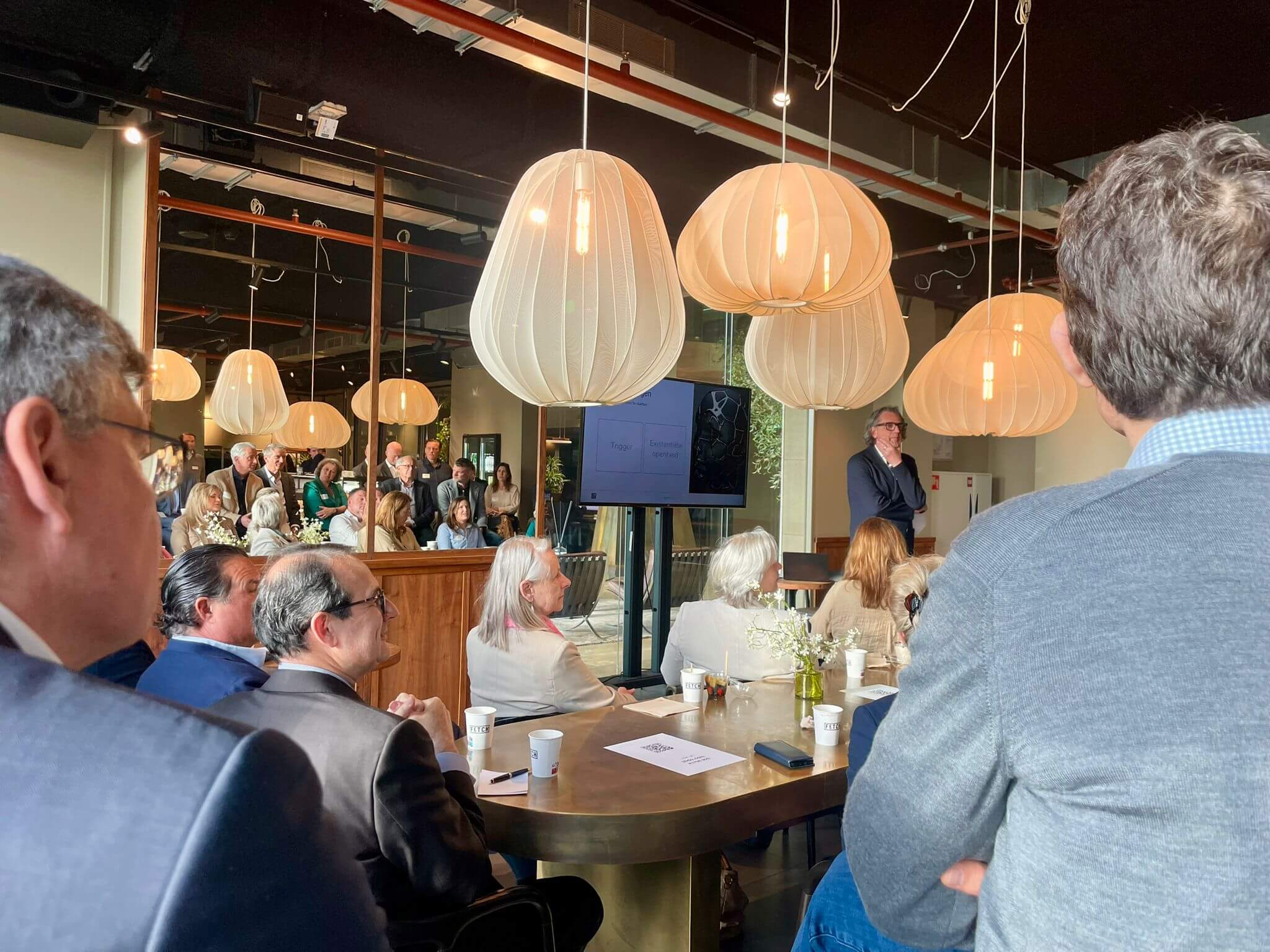

From trigger to transformation: what a breakfast with fifty executives taught us. On the morning of Friday 17 April, nearly fifty executives gathered for breakfast. Eight o'clock, early enough to still feel the stillness before the day began. What was intended as a forty-five-minute resonance session delivered far more. Those present proved willing to be open, to share their own stories and to genuinely challenge one another. The atmosphere was pleasant and relaxed; the content sharp. That says something about the subject.
Why resilience, and why now
The world is changing at pace. Technological breakthroughs, geopolitical uncertainty and the advance of disinformation follow one another in quick succession. As a result, more is being asked of those who carry ultimate responsibility than ever before. At the same time, coaching practice shows that conversations with executives are increasingly less about strategy and increasingly more about endurance. The research by Ed van der Sande (partner at Odgers) at Vrije Universiteit Amsterdam, as part of the Executive Master in Coaching, takes that observation and his own experiences as its starting point. The study combines fifteen in-depth interviews with executives, coaches and experts with a survey of one hundred and eleven executives. The central question: how do executives develop resilience, under what conditions, and with what support?
The subject is not only relevant to Leadership; the research had a tangible effect on the reflections taking place in the moment itself. That was palpable in the room, and gave it an added learning value for me.
Two foundations, four phases, four sources
Before resilience can manifest itself, two conditions must be in place. A trigger, a concrete experience that activates the process. And existential openness, the willingness, when faced with adversity, to examine not only the situation but also yourself. The second is rarer than executives themselves tend to think. Self-confidence and genuine openness are not the same thing. This prompted a thoughtful and substantive discussion about existential openness: what it entails, how it can be achieved, and positive experiences of having it were shared.
When those foundations are in place, resilience in executives unfolds across four phases. Anticipate, in which you deliberately build a stable base. Act, in which you make choices while the pressure is on. Recuperate, in which you actively give yourself room to recover. And Transform, in which you embed your insights and, where necessary, revise yourself. Together these form the AART model. Each phase has its own logic. Skipping a phase allows you to recover, but not to grow.
Within each phase, executives draw on four source domains: regulating (physical), processing (emotional), stabilising (mental) and reappraising (cognitive). They function as an interconnected system. Investing in breadth yields more than depth in a single domain.
What sets executives apart is not whether they experience adversity. It is whether they are willing to live through it fully.
What the room revealed
The session opened with a personal question: think of a moment in the past five years when your resilience was truly put to the test. Not a difficult week, but a moment that genuinely mattered. After the model was presented, a series of provocative propositions followed, each drawing on a striking combination from the data.
The first proposition concerned self-knowledge. Almost all respondents say they have a clear sense of the values that guide their conduct. At the same time, the vast majority acknowledge that they miss important aspects of their own behaviour without feedback. Self-knowledge without critical feedback is self-deception. The room recognised this. A discussion arose about which conversational partners genuinely dare to hold up the mirror, and which do not.
The paradox at the top drew sharp reactions. The qualities that bring executives to the top, such as results-orientation, perseverance, autonomy and the drive for control, are, for executives at the top, precisely the qualities that block recovery. Pressing on after a crisis is, in that sense, not resilience. It is deferring the bill. Several participants described, in recognisable terms, how that bill was eventually presented to them.
A third insight concerned the conversational partner itself. The majority process emotions through their partner or friends. Only a narrow minority engage an independent professional. The flip side is underexposed: those close to you almost always have a stake of their own in the outcome. That does not, by definition, make them the best person to talk to. The forcefulness of the proposition sparked considerable debate, given that a partner also knows you best. The question that emerged during the discussion, and that participants continued to reflect on, was: 'Who is truly there for you? Without an interest, without an agenda.'
The challenge of reflecting once again on how I dealt with certain "compelling events".
The resilience matrix as a mirror
The session closed with a personal exercise. Four phases multiplied by four source domains yield sixteen intervention zones: the resilience matrix. Participants were given sixty seconds to look back at their own moment and mark where in the matrix they had let something slip at the time. Not what they had done well, but what they had skipped over. The silence in the room was palpable. The responses that followed were candid and concrete.
Five Takeaways
- Resilience is not a trait, but a process. It unfolds in phases and cumulatively, only through interaction with real experience.
- Existential openness determines the depth. A trigger activates; openness determines how far the learning process reaches. Self-confidence is no substitute for it.
- Every phase counts. Skipping Recuperate in order to press on undermines the next cycle. Pressing on, in that case, is not resilience but postponement.
- Invest in breadth, not in a single domain. Physical exhaustion undermines emotional regulation; emotional overload erodes mental clarity. The four source domains function as a system.
- Choose the right conversational partner. A partner, friends and colleagues are available, but not by definition independent in every case. Professional support works most powerfully as a structured process across multiple cycles, not as a one-off crisis intervention.

Never miss an issue
Subscribe to our global newsletter to discover our latest insights, opinions and featured articles.
Follow us
Join us on our social media channels and see how we're addressing today's biggest issues.