

How Boards and CEOs Can Build Stronger Leadership
6 min read

Delivery of demanding mandates today depends less on an individual, the CEO and more on how the leadership works together.
In an era of persistent uncertainty, organizations that build integrated, sustainable leadership will outperform those reliant on individual leaders or current executive teams.
 The key question is no longer “Do we have the right CEO?” but “Do we have the right joined-up and depth of leadership in place?”
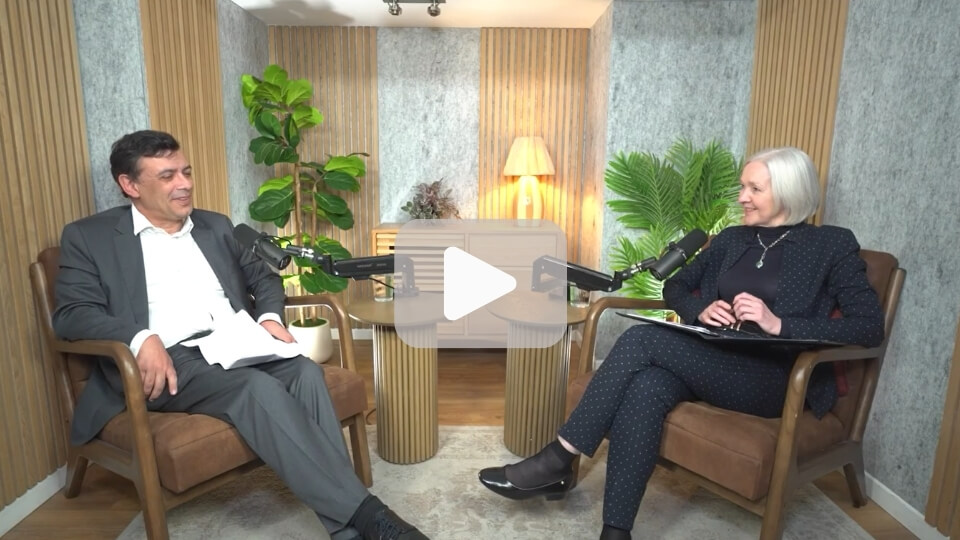
As part of our Leading Through Uncertainty series, Liz Stewart, Chair of Odgers' Leadership Advisory UK joins Luís Sítima, Managing Partner of Odgers Portugal and Head of Leadership Advisory across EMEA, to explore how leadership must evolve.
The discussion explored:
- Why reliance on individual leaders is becoming a structural risk.
- How organizations build integrated and benchstrength in leadership.
- What boards must do to actively shape and oversee the optimization of integrated leadership.
How Boards and CEOs can Build Stronger Leadership | Explore the episode your way: watch the conversation, listen on Spotify,
or read the full article below
Explore All Episodes: Leading Through Uncertainty
Follow on Spotify | Subscribe on YouTube
Leadership is collective, not individual
The fundamental mistake many organizations still make is treating leadership as individual brilliance. In today’s environment, that is risky.
Uncertainty is not episodic anymore; it is structural. According to a recent study, nearly 50% of CEOs believe their organizations will not survive in 10 years’ time on their current path.
Leadership must evolve from top-down decision-making to a distributed, data-informed, future-oriented and agile way of operating.
Anticipate, inspire, deliver
The fundamentals of leadership remain, but the tempo and expectations have changed.
The effectiveness of collective leadership is defined by three capabilities which must all be present:
- Anticipation - seeing what’s coming around the corner.
- Inspiration - energizing colleagues to elevate their contribution.
- Delivery - executing results across multiple initiatives and levels.
These capabilities are not the responsibility of a single leader. They must be owned and embedded by leaders across all levels of the organization.
What has changed are the critical characteristics of leaders to embrace successfully velocity and complexity. Anticipation now operates on shorter cycles and strategy must bridge long-term vision with regular check-ins and rapid adaptation. Decision-making must rely less on instinct and more on structured insight, especially around people.
Boards focusing executives on delivering outcomes must also assess whether these capabilities are consistently strong across the leadership as a whole, not just in the CEO.
Talent is how the system is built
One of the few controllable variables for CEOs is building the talent pipeline, yet many leaders lack the same level of insight into people that they have for finance or strategy. Without this focus, it becomes difficult to secure consistent, high-performing leadership.
Leading organizations are correcting this by applying data and analytics to human capital decisions, evaluating, monitoring and taking decisions about talent with the same rigor as financial performance.
This includes deep behavioral insights into how leaders operate under sustained pressure, uncertainty or ambiguity with team analytics to determine the strengths and opportunities to optimize collective performance and supported by forward-looking succession planning aligned to strategy.
Boards must elevate talent pipeline discussions from periodic reviews to continuous, data-driven strategic conversations which:
- Demand visibility on the leadership bench strength and pipeline sustainability.
- Insist on evidence-based succession plans (with plan B, as well as C and D for critical roles).
- Check alignment of future leadership profiles with strategic direction.
The shift from hierarchy to “team of teams”
Leadership systems which operate in silos cannot function effectively or optimally.
Today, the greatest performance gaps no longer occur within teams, but between them. As a result, leadership effectiveness depends less on individual or siloed team’s authority and more on the organization’s ability to operate as a connected “team of teams.”
At the same time, effective decision-making increasingly depends on diversity of thought and structured challenge. In complex environments, homogeneous leadership limits innovation and judgment.
Boards should actively challenge CEOs not only on how effectively the organization is connected, but also whether intentional collaboration is intentionally designed and measured across leaders and leadership teams, yielding added value outcomes and ensure that leadership incentives reinforce enterprise-wide outcomes rather than siloed success.
The question is no longer whether strong individuals exist, but whether the organization enables and requires them to perform collectively at all levels.
The critical role of the board
Ultimately, although the board is responsible for the effectiveness of integrated executive leadership across the organization, they are also expected to be active contributors.
For high-impact boards that means explicitly committing to the leadership responsibilities of the board as well as actively governing the effectiveness of the entire leadership bench strength. Ensuring it is fit for the future, not just fit for today includes being confident in the:
- Alignment between strategy and leadership capability.
- Strength and resilience of the leadership pipeline.
- Organization’s ability to adapt and create long-term value through its leadership.
The most effective boards focus less on monitoring results and more on testing whether the current and emerging leadership is sustainable.
The bottom line
Leadership is no longer defined by the strength of a single individual, but by the effectiveness of intentional, integrated, horizontal and vertical leadership capabilities and performance.
In a volatile world, strategy can be copied and technology can be acquired but integrated, strong and relevant leadership cannot. Integrated leadership is built over time, through deliberate attention, design, investment and discipline. Organizations that continue to rely on individual leaders will become increasingly fragile.
Outperforming boards and CEOs will:
- Recognize that leadership is collective and integrated.
- Treat leadership talent as a strategic asset to be built.
- Design organizations that enable connectivity rather than reinforce hierarchy.
- Actively role model, evaluate, invest and monitor the impact of collective leadership quality and bench strength.
Leadership is no longer about titles, levels and who leads. It is about how leadership recognizes, commits and actively works through diverse perspectives and contribution to optimize collective performance and benefits all involved.
____________________________________________________
Odgers provides integrated executive search and leadership advisory services. We are deeply rooted in our local markets, which we combine with global perspective and reach to help organizations build transformational, world-class leadership teams.
Get in touch. Follow the links below to learn more, or connect directly with our dedicated executive search experts and Leadership Advisory consultants at your local Odgers office here.
What is collective leadership and why is it critical for CEOs today?
Collective leadership refers to an organisation’s ability to distribute leadership responsibilities across teams rather than relying on a single CEO or executive. In today’s volatile and complex environment, relying on individual leaders creates structural risk. Effective organisations build integrated leadership systems where multiple leaders contribute to anticipating change, inspiring performance, and delivering results. This approach increases resilience, improves decision-making, and ensures leadership continuity across the business.
How can boards and CEOs build stronger leadership bench strength?
Boards and CEOs can strengthen leadership bench strength by treating talent as a strategic asset. This includes developing data-driven succession planning, identifying future leadership needs aligned to strategy, and building multiple contingency plans (Plan B, C and D) for critical roles. Leading organisations also invest in assessing and developing internal talent pipelines while combining external hiring with long-term leadership development.
What are the key capabilities of effective leadership in uncertain environments?
Effective leadership today is defined by three core capabilities:
- Anticipation: The ability to identify future risks and opportunities in fast-changing environments.
- Inspiration: Motivating and aligning diverse stakeholders across the organisation.
- Delivery: Executing strategy and achieving results despite ambiguity.
These capabilities must exist across leadership teams, not just the CEO, because uncertainty requires faster, more distributed decision-making.
Why is a “team of teams” leadership model more effective than traditional hierarchies?
A “team of teams” model enables organisations to operate with agility and collaboration rather than rigid hierarchy. Performance gaps today often occur between teams rather than within them, making connectivity critical. This model focuses on orchestrating collaboration, reducing silos, and aligning teams around shared goals. It improves innovation, responsiveness, and enterprise-wide decision-making by leveraging diverse perspectives.
What role should boards play in shaping organisational leadership?
Modern boards play a more active role in leadership than traditional oversight. They are responsible for challenging strategy, ensuring leadership sustainability, and aligning talent with long-term business goals. This includes evaluating leadership capability, overseeing succession planning, and bringing diverse perspectives to decision-making. High-performing boards act as strategic partners to the CEO, helping to future-proof leadership and drive long-term value creation.
How can organisations use data and analytics to improve leadership performance?
Organisations can enhance leadership effectiveness by applying data and analytics to talent decisions. This includes using behavioural insights to assess how leaders perform under pressure, analysing team dynamics to optimise collaboration, and leveraging predictive analytics for succession planning. By treating people decisions with the same rigour as financial analysis, companies can build stronger, more resilient leadership systems and make more informed decisions about talent.

Never miss an issue.
Subscribe to our global magazine to hear our latest insights, opinions, and featured articles.
Follow us
Join us on our social media channels and see how we’re addressing today’s biggest issues.