

Measuring Up: Evaluating Board Performance in Portugal and Denmark
6 min read


Odgers sees high marks for Board Chairs, but lower grades for ‘People and Skills’ – and many areas for improvement.
A well-functioning Board is crucial for long-term company performance.
So, it’s essential for companies to adopt a systematic, regular and thorough evaluation of Board effectiveness. This also helps non-executives improve their own personal performance in a methodical way.
Our recent surveys of Board performance in Denmark and Portugal provide significant pointers for future improvements. By highlighting two relatively small, diverse markets, we see not only their different, country-specific challenges, but also common features that apply elsewhere too. Moreover, by using qualitative and quantitative surveys, we reduce the risk of anomalous distortions in a single approach.
Best in Class
Generally, the evaluation process should encompass Board composition, value creation, succession planning, dynamics, culture, process and the relationship with the CEO and executive team.
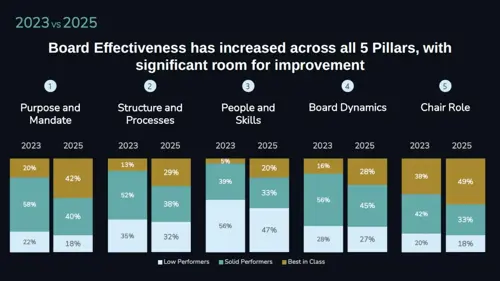
Overall, Boards score especially well on the ‘Chair’s Role’, though less so on ‘People and Skills’ (see below).
In our 2025 Board Effectiveness Survey for Portugal, we looked at more than 150 executive and non-executive Board members from private and listed companies across several sectors.
The picture is encouraging. More than 1 in 5 (21%) overall reached ‘Best in Class’ rating, while an additional 52% were ‘solid’ performers, regardless of company size. The remainder formed a long tail of declining outcomes. Good Board performance also correlated to profitability. Perhaps unsurprisingly, Boards of listed companies, subject as they are to greater regulatory and market scrutiny, performed best.
The Chair’s Critical Role
The ‘Chair’s Role’ was evaluated as the most effective dimension, with 82% rating their Chairs positively. Significantly, almost half (49%) scored a ‘Best in Class’ rating, up from 38% on a similar 2023 survey. In fact, the highest rated performance in Portuguese Boards related to an excellent working relationship between the CEO and the Chair (85%), “characterised by trust, respect and cooperation.” More than three-quarters (78%) also felt that the Chair provided strong leadership.
Similarly, in Odgers’ evaluation of Danish companies, the Chair’s ability to lead meetings, create a framework for constructive debate, ensure participation, and handle complex topics, was consistently deemed important for value creation.
Drilling deeper, the surveys show that a ‘Best in Class’ Chair will generally facilitate open, constructive feedback, encourage onboarding of new members, and keep an eye on succession planning.
However, respondents note that more can be done to draw in new voices, strengthen teambuilding skills, and dedicate more time to strategic discussions rather than getting bogged down in technical details.
Respondents also want the Chair to help members develop new competencies – especially tech skills – and then see these skills put into action. In Portugal, when asked what the leading challenges were, the two biggest concerns were ‘cybersecurity’ followed by ‘technology and new ways of working’.
Such evaluations should form an annual cycle. Every three years, the Board can undertake a more comprehensive assessment. These might involve an external facilitator to introduce fresh perspectives, especially following a major shift business conditions.
Portugal Boards: Minding the Skills Gap
While Portuguese Boards can generally be proud of their Chair’s performance (see above), the ‘People and Skills’ dimension lagged, with a score of only 53%. The category comprises: Size and independence; Skills diversity and balance; Focus and dedication; Board composition for the future; Succession planning; and Recruitment priorities. Previous Odgers research found that, although gender diversity is improving, it still lags behind European best practices.
Only 20% of companies surveyed were deemed ‘Best in Class’ in the ‘People and Skills’ category overall. While almost half (47%), were considered ‘Low Performers.’
What Comes Next?
The biggest people-related challenges for Portuguese Boards relates to effective planning of non-executive or CEO succession, including how the new member aligns with strategy. This scored only 13% ‘Best in Class’, while only 15% felt they adequately recruited the best NEDs. Only half reported that they review this issue regularly, a particular problem for non-listed companies. When it comes to reviewing whether NEDs have relevant skills, most importantly digital and industry skills, only 19% were truly satisfied that they do so with sufficient regularity, or that the skills are aligned with the company strategy.
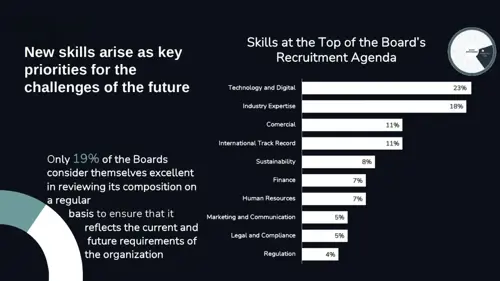
Given the importance of NED recruitment and CEO succession, it is perhaps surprising that only 18% of companies surveyed said they had a budget allocated specifically for NED search, assessment and training.
Larger companies performed better than smaller firms on this measure. Similarly, difficulties recruiting might be related to the finding that only 64% (21% as ‘Best in Class’) felt they had the right compensation model. And these results were roughly similar across all types of ownership structure.

Never miss an issue
Subscribe to our global newsletter to discover our latest insights, opinions and featured articles.
Follow us
Join us on our social media channels and see how we're addressing today's biggest issues.