

Don't Be a Bystander
6 min read
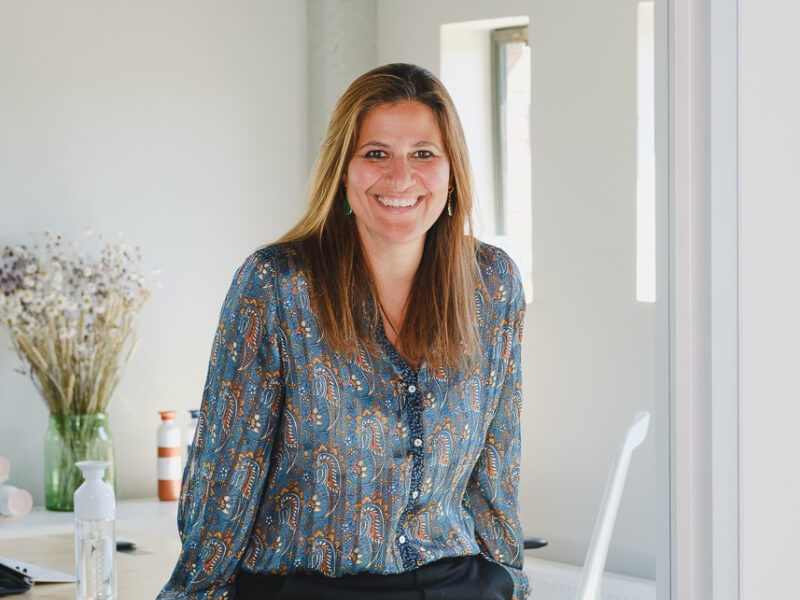

Rosanne Ferrari spoke with Virginia Yanquilevich, CEO of Dopper, shortly before her departure to New York, where she will address hundreds of international executives during UN Climate Week. A conversation about a mission, a career and a conviction that began at a kitchen table in Buenos Aires. What recurs throughout that conversation connects to Leading Through Uncertainty, Odgers' theme for the year: the mission remains the fixed point. Whether an approach works, whether people follow, whether it is ever enough, remains uncertain. This makes the conversation a portrait of leadership driven by intrinsic motivation: continuing to move forward, even when direction does not present itself and the current runs strong against it.
A question at the kitchen table
Virginia was thirteen when her parents asked her something she has never forgotten. She had told them what she saw in her city: the sharp contrasts between wealth and poverty, people begging while others looked away.
If it bothers you this much, why aren't you doing anything about it? her parents asked her.
Not long after that, she signed up for volunteer work in the south of Argentina. What she saw there, a school without access to clean water and children walking for hours to fetch it, she could no longer ignore. That experience made the inequality around access to clean water tangible. What had seemed like a societal issue became something she could see, feel and understand.
That experience laid the foundation for a conviction she has held onto ever since: not looking away, and not waiting for someone else to solve it.
Success that did not feel like success
Years later, Virginia built a commercial career that was, on paper, successful. Targets were met, revenue grew. Yet that success did not feel like success to her. She missed the question of what her work was ultimately contributing to. A coach gave her an assignment: write down ten companies she would genuinely want to work for. Ten times, she wrote the same answer: Dopper.
She applied, despite not meeting the job requirements. The conversations that followed, including an unconventional introduction to founder Merijn Everaarts, were not about a CV, but about a vision. For Virginia, it was immediately clear: this is where she wanted to be.
The mission as horizon
At Dopper, everything centres on one mission: a world without bottled water, where everyone has access to clean water. An estimated one in four people worldwide lacks that access.
For Virginia, that mission is not simply a starting point, it is the one constant. Whether an approach works, whether a project lands, whether people follow, that remains uncertain. The mission does not.
We never negotiate on the mission. Never.
That same shift is reflected in how she fulfils her role. Where she used to focus mainly on day-to-day execution, "working in the business", in recent years she has increasingly moved towards "working on the business": the question of where the organisation is heading, especially now that the path there is no longer fixed. This is not about finding one perfect solution, but about continuing to move in the right direction.
Deciding without guarantees
That shift became most visible during the coronavirus period. There was no protocol, no certainty about what was right. But someone still had to decide. For Virginia, this became a turning point. She realised that leadership sometimes means providing direction without any guarantee. Since then, she has spoken up more clearly.
What she has had to learn is that making a decision does not mean everyone will follow. And that this is fine.
You make a decision with what you know at that point. And afterwards you have to accept that not everyone follows.
Doubt allowed, not delayed
The fact that she makes decisive calls doesn't mean she's never in doubt. The difference lies in what she does with it. For different issues, she has a small, fixed group of people she can turn to, someone different depending on the topic. But not every doubt immediately warrants a conversation.
Sometimes I first need to just sit with it. Only then does it become clear what the question actually is.
Doubt isn't a sign that something's going wrong for her. It's part of how she reaches a decision: first taking the space to understand what's actually at play, only then seeking dialogue.
The backpack that never empties
Anyone working on a problem of this scale can't escape the question of whether it will ever be enough. During field visits to projects in Nepal, Virginia regularly sees what remains of earlier aid initiatives from various organisations, such as materials left abandoned on site years later.
Then you think: what do we actually amount to?
There isn't a definitive answer to that question, and there never will be. Yet she keeps moving, not because she knows it will be enough, but because standing still isn't an option. That takes more than conviction alone. It takes perseverance, flexibility and the ability to keep swimming against the current, even when results aren't immediately visible. To sustain that, self-care isn't a side issue for her. Exercise, time with her family, walking, reading about behaviour and psychology: these aren't breaks from the work, but the condition for being able to keep doing it.
Change starts with behaviour
Dopper doesn't change bottles, it changes behaviour. Virginia translates that conviction into a practical approach, shaped in part by training at the Behavioural Change Academy. Most people do want to contribute, she finds. The question is mainly how you understand behaviour and make it as easy as possible to do the right thing.
One example is the Dopper Wave, a pledge to never drink bottled water again. Virginia signed that pledge herself, years ago, and still feels its impact today. The pledge carries through into small daily choices. Even at conferences, where a bottle of water sometimes still appears on the table as a matter of course, or when asking for tap water at a restaurant in the Netherlands, she remains aware of what such a choice means.
The stage in New York
Dopper has worked with WaterAid for years on clean drinking water projects in Nepal. This year, they are completing a pilot in Changunarayan, a municipality of around 60,000 residents near Kathmandu. The project goes beyond installing water points. It maps out what is needed to structurally organise access to clean drinking water: from financing and management to quality control and the role of local government and community. The ambition is to turn this pilot into a proven, replicable model that can also be applied in other municipalities and countries. This is why the approach is being shared open source, not only to make knowledge available, but above all to help accelerate access to clean drinking water worldwide.
From the outset, it was clear that the lessons from the project needed to be shared. At the end, Dopper will publish the blueprint, including the mistakes, so other municipalities can build on it. Dopper will present that blueprint this summer during World Water Week in Stockholm.
Through the UN Global Compact, the network of businesses originally set up by Kofi Annan, an invitation follows for an even larger stage: UN Climate Week in New York, during the UN Global Compact Leaders Summit, addressing a room of influential international CEOs. In November, COP in Turkey is also on the agenda. For Virginia, the scale of that stage isn't a goal in itself. The greater the reach, the greater the chance to advance the mission.
Love and warmth as a foundation
Behind the scale and ambition lies something small and constant for Virginia. She believes strongly in love and warmth as a foundation, at home and at work. It's the same conviction instilled in her as a thirteen-year-old girl: don't look away, do something, however small. Giving a child without lunch a sandwich. Ordering tap water, even when others at the table look on strangely.
For her, these aren't separate gestures, but variations of the same choice: taking responsibility where you have influence. She wants to be able to tell her story as a whole, from beginning to end, so people understand what it's really about. Whether the stage is a schoolyard or the UN General Assembly, for Virginia Yanquilevich, leadership ultimately remains a personal choice. Don't look away. Keep moving, even without any guarantee that it will be enough. Don't be a bystander.
Would you like to know what mission-driven leadership looks like in practice, or would you welcome a conversation about leadership in uncertain times? Get in touch with Rosanne Ferrari, Partner Business & Professional Services.
Never miss an issue
Subscribe to our global newsletter to discover our latest insights, opinions and featured articles.
Follow us
Join us on our social media channels and see how we're addressing today's biggest issues.