

Strategic Team Coaching: Unlocking the Collective Power of Leadership Teams
5 min read


The leadership context has changed. Not gradually, but fundamentally. Market volatility, vocal shareholders, and the ripple effects of war and technological risk are no longer exceptions; they have become the baseline. Organizations now operate in a state of constant tension, where uncertainty has become the only constant and where AI is both a leverage and an amazement to deeper explore.
Inside, the story is no simpler. New generations are reshaping what they expect from work, ways of working continue to evolve, and global businesses must lead through local nuance. The paradox is striking: we have never had such technically capable leaders, yet teams have never demanded more from them. And most leaders are still responding to today’s challenges with yesterday’s reflexes.
The world is evolving; leaders must evolve too
What we see every day working with clients is that many leaders perform strongly as individuals but overlook critical dimensions of leadership such as anticipating trends and inspiring people in a broader sense, including their teams, peers, and stakeholders. This pattern is consistently reflected in our data. Based on Odgers’ leadership assessment results, senior leaders are on average 9% stronger in execution savviness than in people and team development, and only 24% demonstrate distinctive capability in strategic thinking. When it comes to self-assessing leadership derailers under pressure, 36% of leaders narrow their focus to individual delivery and tend to micro-manage. In practice, this means that many leaders might be limiting their impact to that of an individual contributor: highly capable of delivering tasks themselves but failing to multiply their impact by shaping collective strategy, aligning teams, and developing others. In short, instead of leading, they retreat into execution.
A focus on performance alone does not create effective leaders
This exposes the trap: what got us here will not get us there. Being a top performer does not qualify anyone for being an effective leader. Leadership is about scaling impact through people and through vision. In our experience, this imbalance is clear when we look at the three core dimensions of effective leadership: anticipating (opportunities, risks, trends), inspiring (people, stakeholders at large), and delivering (results). Our data shows that, on average, Portuguese leaders spend 50 to 60% of their time focused on delivering, leaving limited space for anticipating future challenges or inspiring their teams. This overinvestment in execution reduces leadership impact to the level of individual contribution and prevents organizations from developing the collective capacity to adapt and grow. A new generation of leaders is being shaped with the same limitations: strong on execution, but less so on anticipation and inspiration. Left unchecked, this will create a pipeline of leaders who may excel as individual contributors but fall short in enabling their organizations to evolve. Meanwhile, younger generations entering the workforce demand more: purpose, impact, and meaning in their work, and they expect leaders to inspire and empower them. Technical mastery or “knowing how to do” is no longer enough. Meeting these expectations requires nothing less than a paradigm shift in how leadership is exercised.
Individual performance cannot replace collective effectiveness
The answer might lie in adopting a systemic view of teams. Leadership cannot depend solely on the perspective or performance of an individual leader; it requires the entire team to evolve, learn, and act collectively around a shared purpose. This is particularly true for teams of leaders, where the leader’s role is to enable, facilitate dialogue, integrate diverse perspectives, and help the group adapt together. True effectiveness emerges when the team co-creates value with its stakeholders, not just within its boundaries. Without this shift from individual excellence to collective intelligence, leadership remains incomplete and much of its potential untapped.
So, the question is: are we approaching teams as strategic and integrated ecosystems?
To reflect on this, consider the following questions that reveal how teams really operate and create value:
Why do the same people who excel individually sometimes underperform when they sit around the same table?
Team success is never just the sum of individual talent. Under pressure, unspoken dynamics surface and collaboration often breaks down. When these patterns go unexplored, teams lose the opportunity to transform individual strength into collective capability. From our experience, many senior leaders still lead in a vertical and transactional way, relying on the maturity and technical expertise of each team member and engaging with them individually rather than as a collective. This often results in fragmented decision-making and limited collaboration, which in turn weakens innovation and erodes trust within the team. When asked what most needs to improve to enhance executive team effectiveness, leaders consistently identify building trust, lack of communication and collaboration as their top of mind development priorities.
Is there a common vision of the team’s purpose?
When clarity of purpose is missing, teams default to “busy delivery” instead of aligning around shared priorities. The result is duplication, energy scattered across low-value work, and loss of focus on the battles that really matter most for the organisation. When we ask to describe their team’s purpose, leadership teams often provide as many answers as there are members. This fragmentation is not due to lack of competence or commitment (most leaders are deeply invested in their areas of expertise) but to an absence of shared direction. Without a unifying purpose, individual excellence does not translate into collective progress. Once the team invests time in defining its shared mission and clarifying how each function contributes to it, priorities are aligned, collaboration become intentional, and the team starts operating as a single leadership body, “one team”, with a clear sense of direction and impact.
How well does your team connect with its key stakeholders to create value?
Senior teams are measured not only by how well they align internally but by the value they generate for those who depend on them. When stakeholder engagement is fragmented or delegated to individuals, opportunities are missed, and credibility weakens. The real shift occurs when the team takes collective ownership of these relationships, working together to build alliances and co-create impact. When leadership teams are invited to map their key stakeholders, it is common to see a wide range of answers. Some prioritize clients, others focus on employees or shareholders, while critical players such as regulators or strategic partners are sometimes overlooked. This inconsistency often leads to stakeholder management that is reactive and operational, guided by immediate needs rather than a deliberate, long-term strategy. Teams that align on a common stakeholder map and a clear engagement approach move beyond transactional interactions, building stronger relationships and a more purposeful impact across the system.
Are we anticipating tomorrow’s disruptions, or just reacting to today’s urgencies?
Delivery pressure makes it easy for teams to focus on the present, yet resilience depends on their ability to anticipate and shape what comes next. This requires a systemic view that integrates political, economic, environmental, and technological shifts likely to redefine industries. Without it, organizations respond too late and lose strategic agility. Business history is filled with warnings. Blockbuster turned down a partnership with Netflix, confident that people would never stop renting physical movies; within a decade, it was gone. More recently, Nokia’s dominance in mobile phones vanished almost overnight when it failed to see how smartphones would transform user behavior. Today, similar risks are emerging around artificial intelligence. Some organizations, like Amazon, are already redesigning their operating models to embed AI across logistics, customer experience, and product innovation, creating new efficiencies, capabilities and business opportunities. Nvidia anticipated this shift years ago, positioning its technology at the core of AI development and becoming one of the most valuable companies in the world. Others, however, remain hesitant, waiting to “see where it goes.” The gap between the two is widening quickly. Executive teams play a decisive role in closing it, yet many still operate with an inward-looking perspective focused on short-term performance. Future-ready teams look outward, cultivating partnerships, learning from disruption, and adapting before change forces them to.
Organizations unlock resilience when teams work systemically
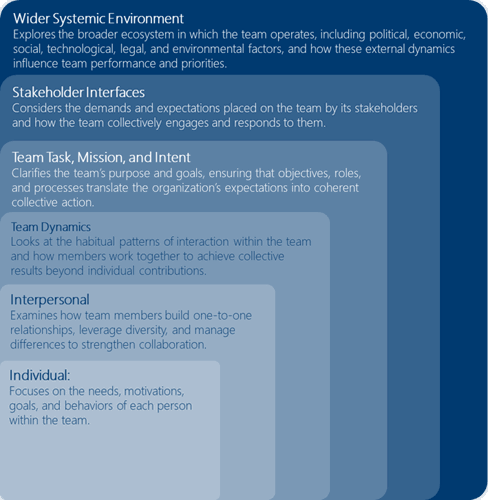
A systemic approach is more than a way of reflecting on team effectiveness and impact; it is a mindset shift in how teams think, connect, and act. Teams that work systemically understand that their performance does not exist in isolation. Their value depends on how clearly they are commissioned, how aligned they are on purpose, how effectively they co-create, and how deeply they connect with their stakeholders and environment. By broadening their attention beyond internal goals to include the organization and ecosystem around them, teams move from reacting to the present to shaping the future.
This way of working also accelerates collective learning. Instead of treating challenges as individual or functional issues, systemic teams use them as opportunities to learn together and strengthen collaboration. They become more adaptive, more attuned to external change, and better equipped to create value in complex environments. As Peter Hawkins argues, resilience grows when teams see themselves as part of a living system, one that includes their stakeholders, their organization, and the broader context in which they operate.
Working systemically enables teams to build a shared vision, consolidate their identity, and understand how they interact with the wider system, turning awareness into alignment and alignment into sustainable performance.
At Odgers, we help leadership teams take this step by supporting them in navigating business challenges with a systemic perspective, addressing dysfunctions, connecting to the wider ecosystem, and strengthening stakeholder alliances. It is not about problem solving, but about creating the conditions for challenge, learning, and growth. In our experience, this approach delivers disproportionate impact: it accelerates alignment, improves stakeholder engagement, and enables organizations to anticipate market shifts with confidence. We work with leadership teams directly on their business agenda, connecting internal dynamics with external ecosystems and anchoring role-modelling at the core. The result is leadership teams that evolve, learn, and act together with purpose, building organizations that are more adaptive, resilient, and ready for the future.