

Leadership in Uncertain Times: Nikola Steinbock on Change, Responsibility and Future Strength
8 min read
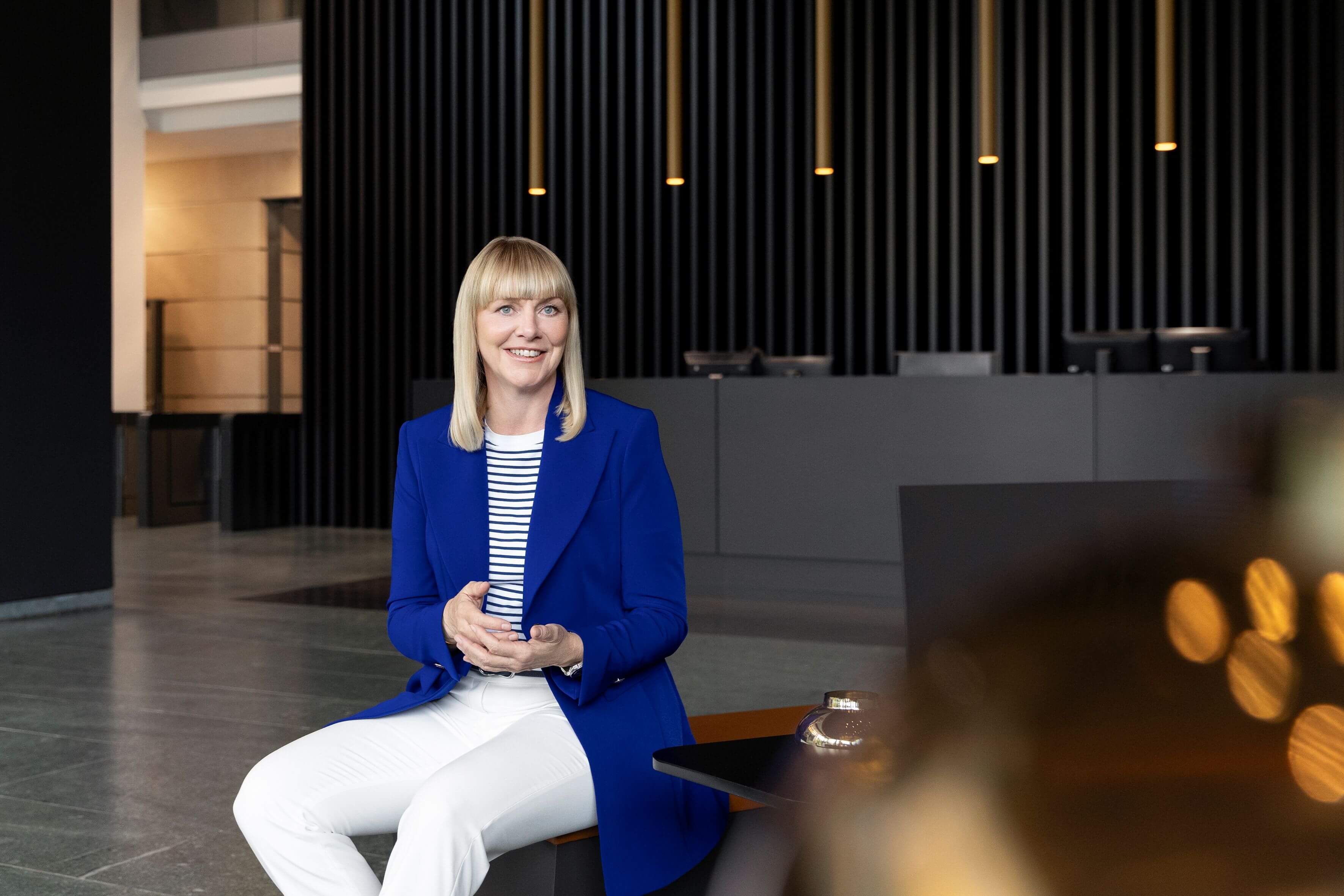

How do you lead an organisation when uncertainty is no longer the exception, but part of everyday reality? In conversation with Dagmar-Elena Markworth, Partner at Odgers, Nikola Steinbock, Chairwoman of the Management Board of Landwirtschaftliche Rentenbank, explains why modern leadership today is less about control and more about clarity, trust and the ability to win people over for shared responsibility.
Agriculture is a prime example of the simultaneity of major challenges: climate change, economic pressure, societal expectations and sustainable transformation all converge directly. As a development bank, Landwirtschaftliche Rentenbank not only supports this transformation financially, but actively helps shape it.
What does leadership mean in an environment where simple answers are rare? How can orientation be created when much remains open? And why are personal responsibility, transparent communication and unconditional cooperation essential if transformation is not to overwhelm people, but instead unlock future strength? Dagmar-Elena Markworth discusses these questions with Nikola Steinbock.
Ms Steinbock, we are living in a time of constant uncertainty. Global crises, transformations and continuous change have become part of everyday life. You lead a bank with a high level of social responsibility. How does this change the demands placed on your leadership?
Uncertainty changes leadership above all because you can no longer claim to have a definitive answer to everything immediately. Today, leadership is less about conveying supposed certainties and more about enabling people, and with them the organisation, to find the right answers to complex issues and questions together.
Leadership today is less about conveying supposed certainties and more about enabling people and organisations to find the right answers to complex questions together.
It is also about providing orientation and repeatedly clarifying: What do we stand for? What is our mandate? And which decisions contribute to that in the long term?
Leaders, myself included, are not the ultimate experts on every topic. Rather, they are the ones who moderate, connect issues and bring people together. That is where our time needs to be invested.
At Rentenbank, I make sure that I spend a lot of time in in-depth dialogue with people: externally with all stakeholders and internally with our employees. This helps me understand the challenges, recognise developments and understand what may result from them for us or what we need.
Many leaders are currently facing the challenge of giving their employees orientation, even though the framework conditions are constantly changing. How do you manage this balancing act?
In my view, this balancing act succeeds through clarity and trust. Clarity about where we want to go, and trust that employees want to and are able to contribute. I do not believe in leadership through control, but in creating spaces in which people can take responsibility. Responsibility is also one of our five corporate values: drive, appreciation, innovation, stability and responsibility.
I do not believe in leadership through control, but in creating spaces in which people can take responsibility.
At the same time, communication is needed. Not only once decisions have been finalised, but also in phases when things are still being weighed up. Employees sense uncertainty anyway. It is therefore better to be transparent about what you know, what you do not yet know and which criteria guide your decisions.
Which qualities do leaders need most today, in your view, and which are becoming less important?
Above all, leaders today need tolerance of ambiguity, meaning the ability to deal with uncertainty, contradictions and multiple interpretations. They also need extremely strong communication skills and the willingness to take responsibility, but also to share it. They must be able to truly listen, bring different perspectives together, and want and be able to make decisions. We have already spoken about uncertainty, so courage is often part of decision making today as well.
In my view, the classic image of the leader who knows everything better and manages through hierarchy has long been losing importance. In complex transformation processes, that approach no longer works. And really, as has always been the case, it makes no sense at all not to include all competencies and capabilities. The result can only become better through different perspectives. What matters is setting up teams in such a way that they can achieve good results together.
You often speak about collaboration, trust and personal responsibility. Were these values that shaped you early on, or did these principles develop over the course of your career?
These values shaped me early on, but they certainly developed further over the course of my career. I have experienced how much becomes possible when people are given trust, and how much energy is lost when organisations operate primarily through safeguarding, control and demarcation.
What motivates me in leadership is shaping something together with employees and achieving tangible and measurable results that improve something for the customer, the employees or the organisation. Success motivates me greatly. At the same time, I also experience moments of happiness when I see people and teams grow. Often, development can be observed in very concrete situations, when I think: “Wow, six months ago he or she would not have analysed or presented that so brilliantly. Fantastic.” For such development, you need an environment in which people can unfold their potential.
A good example is how we developed our 2030 business strategy last year. Many employees were involved in the process, all bringing enormous expertise and different perspectives. We did not bring in a major external consultancy. Instead, we worked with a coach to develop a very forward-looking strategy based on our promotional mandate, one that we all stand behind and implement together every day. It was a strategy process that, almost as a byproduct, helped people grow.
What are you currently observing among younger leaders? Is the understanding of these leadership ideals changing?
I observe that younger leaders, and of course employees as well, have a very clear need for purpose, participation and authenticity. They do not just want to distribute tasks. They want to understand why something is being done. They look for role models who do not just talk, but whose actions are coherent and comprehensible.
At the same time, this has not made leadership easier. Trust does not mean arbitrariness. Modern leadership, too, must make decisions, set priorities and endure and address conflicts. But it does so differently: more dialogically, more transparently and with a stronger focus on collaboration.
Hardly any sector is currently caught as strongly between transformation pressure, economic challenges and societal expectations as agriculture. How does this shape your day-to-day leadership?
Agriculture is a prime example of the simultaneity of our time: climate change, biodiversity, animal welfare, food security, economic pressure and societal expectations all come together directly. This also shapes our day-to-day leadership at Rentenbank as a strong financing partner.
Willingness to change alone is not enough. Businesses need room for investment, reliable framework conditions and access to capital.
We need to further develop promotional instruments in such a way that transformation remains financeable. Because willingness to change alone is not enough. Businesses need room for investment, reliable framework conditions and access to capital. This is precisely where our responsibility as a development bank lies.
How do you manage to pursue long-term sustainability goals when short-term crises constantly demand a great deal of attention?
Short-term crises must not displace goals that make long-term sense. But long-term goals must be designed in such a way that they remain viable even in times of crisis. Sustainability must not remain abstract. It needs to be translated into concrete steps.
One example is the question of how agricultural businesses can reduce emissions while also strengthening their economic base. At Rentenbank, we have therefore developed programmes and instruments that think climate protection, competitiveness and financeability together.
You have had an impressive career in banking, taking you all the way to the top of Landwirtschaftliche Rentenbank. Which experiences have shaped you most personally?
I was certainly shaped by my grandmother, who taught me that diligence and discipline are the foundation of life. But I was also, somehow, quite early on the person who spoke openly when I felt we were taking the wrong turn or pulling the wool over our own eyes in order to take the easiest path. That can make me difficult at times. For me, it is extremely important that discussions are honest, and I am convinced that working relationships only truly carry weight when there is unconditional cooperation in the interest of the matter at hand. I want to be a partner for colleagues, someone they can make use of within the team, with all my strengths. Over the course of my career, I have learned that it is wise to let go of any reluctance to address difficult topics and conflicts. Difficult conversations, or dealing with conflictual meetings or situations, can be learned and conducted in a way that leads to a good outcome in the end.
You became a leader in your early thirties. Looking back on that time, what advice would you give the Nikola Steinbock of that period today?
I would tell her: just do it. That was already my motto back then. Trust your own path and do not wait until you feel one hundred percent ready. Many development steps only arise once you take on responsibility.
Leadership does not mean being able to do everything alone. On the contrary: good leadership often begins with bringing the right people together.
I also always advise people to maintain networks and actively accept support. Leadership does not mean being able to do everything alone. On the contrary: good leadership often begins with bringing the right people together.
After all these years in senior positions, what still motivates you to take responsibility and actively shape transformation?
What motivates me to this day is the ability to shape things. The agricultural and food sector in particular is facing enormous changes. If we can help businesses invest, enable innovation to emerge and keep rural areas fit for the future, then that is a deeply meaningful task.
What personally gives you confidence when you look at the challenges of the coming years?
What gives me confidence is the willingness to change among people in agriculture and among our people at Rentenbank. These people are prepared to deal with uncertainty, whether it concerns weather, markets, political frameworks, societal expectations or how we as a bank respond to all of this. Other sectors could learn a great deal from that.
I also see many innovative ideas: smart farming, new value chains, renewable energies, young founders, the highly competent next generation in agriculture and committed women. If we combine this willingness to change with the right financing conditions, transformation can create genuine future strength.