

Leadership Beyond the C-Suite: CEOx1Day Welcomes Its First University President
7 min read

The title “CEO” belongs to the corporate world. The challenge of leading a large, complex organization does not.
University presidents lead some of Canada’s most complex organizations; ones with thousands of employees, substantial budgets and assets, complex and unique governance structures, and far-reaching responsibilities to students, researchers, communities, and the public. At the University of Ottawa alone, that means leading an institution with a $1.7 billion budget, 12,000 employees, and more than $4 billion in assets and infrastructure.
And yet, the way leadership is exercised in a university can look very different from the traditional corporate model. Authority exists alongside collegial governance. Decisions are shaped by debate and academic freedom. Leaders are surrounded by people who are, themselves, experts in their fields. Success depends not only on making consequential decisions, but on listening, building credibility, navigating competing perspectives, and bringing people together.
That is one reason this year marks an exciting first for CEOx1Day North America.
For over a decade, CEOx1Day has given outstanding undergraduate students the opportunity to spend a day alongside some of Canada’s senior leaders, and see firsthand what leadership and decision-making look like at the highest levels of an organization.
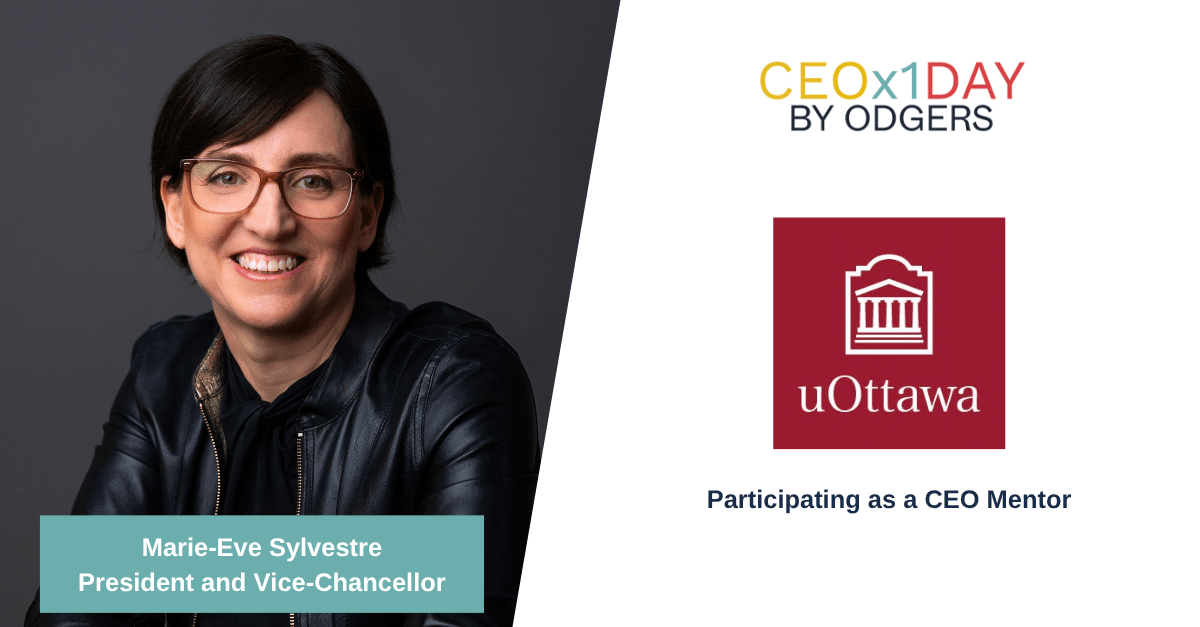
This year, the program is broadening that perspective. University of Ottawa President and Vice-Chancellor Marie-Ève Sylvestre is the first university president to participate in CEOx1Day.
Her participation offers students a different lens on executive leadership, and an opportunity to explore what leading at the highest level looks like in an institution where expertise is everywhere, consensus cannot be assumed, and decisions must balance immediate pressures with a mission intended to endure for generations.
We spoke with Marie-Ève about the university presidency, leading among experts, making difficult decisions, navigating profound change, bringing people together, and what she hopes a student will learn from spending a day in her role.
1. The title “CEO” is most often associated with corporate businesses. But university presidents lead extraordinarily large and complex institutions. Do you think of yourself as a CEO? Where does the comparison fit, and where does leading a university require something different?
Marie-Ève Sylvestre: There are certainly aspects of the role that resemble those of a CEO. uOttawa is a major research-intensive university and a significant civic, social and economic institution, with a budget of $1.7 billion, 12,000 employees, more than $4 billion in assets and infrastructure, and a high level of public accountability. As president, I make consequential operational decisions and am accountable to the Board of Governors, as well as to the broader public we serve.
But a university is not a corporation, and its president does not lead by command. Universities are collegial institutions with a bicameral governance structure: the Board of Governors carries responsibility for financial and administrative matters, while the Senate oversees academic affairs. A president must be able to work across both spheres while remaining deeply grounded in the university’s mission of teaching, learning, research and innovation.
That requires a different form of leadership. I am an academic leader and a peer among experts. My influence depends less on imposing decisions than on listening carefully, building trust and credibility, explaining direction, and bringing people together. The scale of the institution may resemble a CEO role, but the way leadership is exercised is profoundly shaped by academic values and collegial governance.
2. Universities are deliberately places of debate, inquiry and competing perspectives. What has leading in that environment taught you about making difficult decisions when there may be no obvious consensus?
Marie-Ève Sylvestre: Universities are not ivory towers. We feel the pressures and concerns of society, but we also have the privilege and responsibility to step back, examine them carefully and debate them openly. Academic freedom is at the heart of a university. It protects the ability of professors to teach, conduct research, and test ideas without external interference. It also creates an environment in which expertise, facts, reasoned arguments, and different perspectives are valued.
Leading in that environment has taught me that listening is not a procedural step; it is part of good decision-making. Openness does not mean that every position is equally sustainable, or that consensus will always be possible. It means making room for disagreement, testing assumptions from different angles, and being prepared to explain both the decision and the reasoning behind it.
In difficult moments, a leader must create a sense of purpose and possibility while remaining credible. My experience as a professor, dean and academic leader has taught me that credibility is earned through rigour, judgment and respect.
3. A university president leads a community filled with people who are themselves experts and leaders in their fields. What have you learned about exercising leadership when you are surrounded by people who may know far more than you do about the issue at hand?
Marie-Ève Sylvestre: It is one of the great privileges of leading a university. Every day, I work with people whose knowledge, experience and judgment make the institution stronger. Good leadership begins with recognizing that expertise, making space for it, and ensuring it can meaningfully shape decisions.
My role is not to have every answer. It is to ask the right questions, bring the right people together, and understand how their knowledge connects to the institution’s broader responsibilities. At uOttawa, we can draw on our own experts when developing priorities, whether we are considering the future of the Francophonie, environmental sustainability, fiscal accountability, or another complex institutional challenge.
Marie-Ève Sylvestre: I was trained as a lawyer, and that training still shapes how I analyze evidence and weigh competing considerations. But leading a university has reinforced the importance of intellectual humility: knowing what you bring, knowing when to rely on others, and being willing to let expertise change your perspective.
4. Universities are navigating profound change, from AI and technology to funding pressures, changing student expectations and questions about the role and value of higher education itself. How do you determine what needs to change while protecting what should endure?
Marie-Ève Sylvestre: The first step is to identify what must endure: our academic and research mission, our commitment to students, the pursuit of knowledge, academic freedom, and the university’s responsibility to serve the public good. Those principles provide an anchor, but they do not require us to preserve every structure or practice unchanged.
We are currently engaged in a strategic planning process to build a vision for uOttawa’s bicentennial in 2048. This process must be collegial and inclusive, drawing on the experience of students, professors, staff, alumni and community partners. Consultation helps us understand what is changing, assess the consequences from different perspectives, and make better choices about where to focus our efforts.
That also means knowing which institutional strengths should guide how we evolve. uOttawa is a bilingual, research-intensive university in the heart of the national capital of a G7 country, with a history of nation building, opening new paths and serving communities. Change should help us express that identity more fully and strengthen what we offer our students and society. What I value most is that this work is larger than any one person. Lasting transformation is collective.
5. Through CEOx1Day, an undergraduate student will have the opportunity to see your role from a perspective very few students get to experience. When they leave at the end of the day, what do you hope they will understand about leadership that they may not have understood when they arrived?
Marie-Ève Sylvestre: I hope they leave with the confidence that leadership is accessible. It is not reserved for a particular title or career path. People can exercise leadership in their field, their community and their daily lives by understanding who they are, paying attention to the environment around them, and working well with others.
I also hope they see how practical leadership can be. A president moves constantly between large strategic questions and immediate operational decisions, often across very different subjects: students, research, new programs, people, budgets, construction and institutional partnerships. The subject changes, but the discipline remains the same: listen, ask questions, be bold and ambitious while understanding risks and consequences, and make the best decision possible with the information available.
Most of all, I hope the experience expands their sense of what they can aspire to. Leadership is not about having all the answers or standing apart from others. It is about accepting responsibility, bringing people together, and contributing to something larger than oneself.
So what can a university president teach Canada’s future leaders about effective leadership? A lot.
Listen carefully. Ask the right questions. Surround yourself with expertise. Have the humility to change your perspective, and the courage to make a decision when there is no easy answer.
Above all, leadership isn’t about having all the answers or holding a particular title. It’s about accepting responsibility, bringing people together around shared goals, and contributing to something larger than yourself.
That’s a lesson worth carrying well beyond CEOx1Day.
Applications for the CEOx1Day program are open until October 28. For more details and to apply: www.CEOx1DayNorthAmerica.ca

Never miss an issue.
Subscribe to our global magazine to hear our latest insights, opinions and featured articles.
Follow us
Join us on our social media channels and see how we’re addressing today’s biggest issues.